THESIS DESK // 06

research index ↙

SENIOR HONORS THESIS · CARNEGIE MELLON · 2024–25

Speech & Audio LLM Pretraining

Resource-efficient representation learning, synthetic supervision, and the lab where everyone seemed to speak in loss functions.

I joined Bhiksha Raj’s ML & Signal Processing Lab as an undergraduate and worked on my senior honors thesis around a simple question: can speech and audio pretraining be made more efficient by changing the representation and the supervision rather than simply scaling the model?

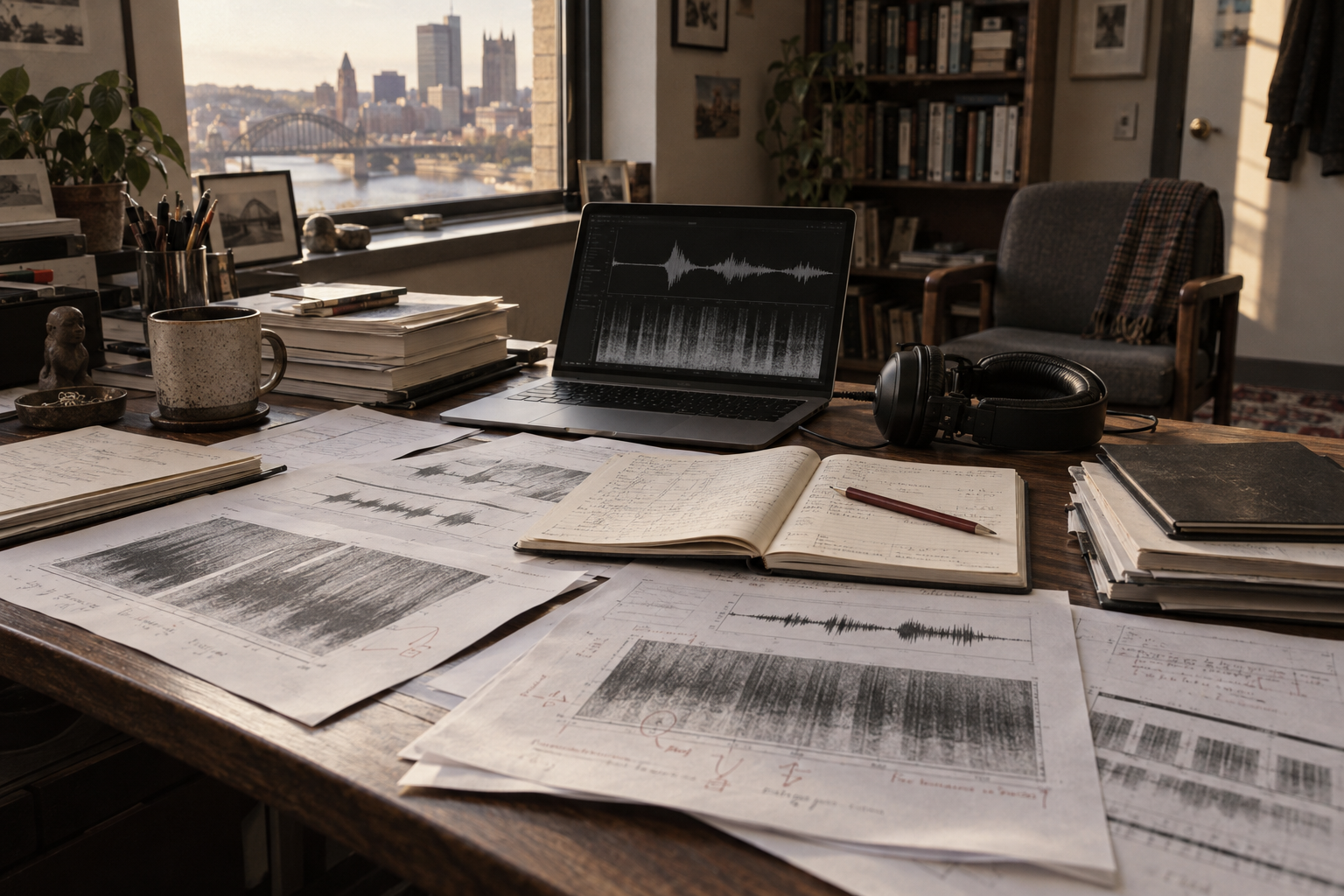
A research desk with spectrograms, notes, headphones, and a laptop
Pittsburgh // representation learning, paper margins, and very patient explanations.

research brief // 06

At a Glance

Question
Can useful speech structure be preserved in much smaller representations?
Direction 01
Compression-based representations for speech/audio pretraining.
Direction 02
Synthetic supervision for modeling speech errors at scale.
Data
LibriSpeech · TIMIT
My role
Model prototyping · data generation · experimental design · evaluation · thesis writing
Outcome
Senior Honors Thesis · Carnegie Mellon
Advisor: Bhiksha Raj

the question

What Signal Is Worth Preserving?

Speech models are expensive partly because their input representations are large and their supervision can be costly to obtain.

My thesis explored two complementary routes: compressing the representation itself, and generating supervision synthetically.

two directions

Representation and Supervision

01

Compression

Can the representation become smaller without becoming useless?

I explored deep compression autoencoders that mapped speech spectrograms from large inputs into much smaller latent representations while attempting to preserve useful acoustic structure.

128 × 128spectrogram↓deep compression autoencoder↓16 × 16latent representation
~28 dB reconstruction PSNR
02

Synthetic supervision

Can speech errors be generated rather than annotated one by one?

I created controlled phoneme perturbations over TIMIT to generate synthetic speech-error examples and trained a classifier to distinguish error severity.

clean speech↓controlled phoneme perturbation↓synthetic speech errors↓severity classification
10,000 synthetic samples · 78% held-out 3-class accuracy

contribution ledger

What I Built

01

Compression experiments

Prototyped autoencoder architectures and evaluated how aggressively speech representations could be compressed while retaining acoustic structure.

02

Synthetic speech-error generator

Built the pipeline producing controlled phoneme-level perturbations over TIMIT.

03

Evaluation workflow

Measured reconstruction quality and downstream classification performance across experimental settings.

04

Thesis

Brought the work together into an honors thesis spanning literature review, system design, experimentation, analysis, and defense.

apprenticeship, really

Learning to Read Research Paragraph by Paragraph

Pittsburgh

The Kind of Teaching That Happens in the Margins

office desk · printed paper · questions about every paragraph

Later, Doha

The Office Became a Laptop Screen. The Patience Stayed.

Zoom · paper notes · the same careful reading

I joined Bhiksha Raj’s lab as an undergraduate, in an environment where everyone around me seemed to casually speak in loss functions.

Some of the most formative parts of this project were not experiments at all. They were hours in his Pittsburgh office going through papers paragraph by paragraph — not just what a method did, but why the authors had made each decision and how an argument was constructed.

When I returned to Doha, those conversations moved onto Zoom. The medium changed; the patience didn’t.

maybe this is where the professor dream really started: being taught with patience, in all the places no one else sees.

trajectory

Why This Still Matters

This thesis changed how I think about efficiency.

Rather than treating larger models and more data as the default path forward, I became interested in asking what structure actually matters, what can be compressed, and what kinds of supervision can be constructed more carefully.

It also changed how I think about academic life. The technical work mattered, but so did experiencing what sustained mentorship looks like from the student side.

methods

Methods

speech representation learning · autoencoders · compression · synthetic supervision · phoneme perturbation · LibriSpeech · TIMIT · PyTorch

thesis

Exploration of Efficient Pre-training Techniques for Speech and Audio Large Language Models